Reach into your pocket and you are performing an act with a surprisingly complicated past. The pocket — that modest pouch sewn into a garment — was not always a given. For much of European history it was an add-on, a privilege, and, depending on your sex, something you might never have had at all.
A Pouch on a Belt
Before the seventeenth century, most people of any gender who needed to carry small objects did so in a separate bag tied to a belt or worn under outer clothing. These were called by various names — gypcière in medieval French, tasca in Italian — and were often more visible than modern pockets, serving as minor status symbols through their embroidery and materials. You advertised what you carried by the quality of the purse you carried it in.
The sewn-in pocket as we know it began appearing in men’s breeches and waistcoats around the 1670s. Tailors realised that a simple opening in a seam, backed by a small linen pouch stitched to the lining, kept objects cleaner and more secure than a dangling external bag. The idea spread quickly through men’s clothing. By the time of the Georgian gentleman — think the stiff coats of the mid-eighteenth century, with their deep coat pockets — a man might carry a watch, a folding knife, a small purse, letters, and a handkerchief all on his person without any visible bulk disturbing the silhouette.
The Deliberate Absence
Women’s fashion took a different path, and the divergence is telling. Eighteenth-century women typically wore separate tie-on pockets — fabric pouches accessed through slits in the outer skirt — that could hold a remarkable amount. Surviving examples show pockets large enough to hold a Bible, needlework, and small tools. They were functional, if hidden.
The trouble began with the high-waisted fashions inspired by ancient Greek and Roman dress that swept Europe around 1800. These silhouettes required thin, clinging fabrics. A bulging pocket ruined the line. Tie-on pockets were abandoned. Women were left with a small reticule — a hand-carried drawstring bag — to contain everything they needed outside the house. The reticule is the direct ancestor of the modern handbag, and it exists largely because a fashion ideal decided that women’s bodies should not disturb their outline with something as useful as a pocket.
This was not merely an inconvenience. Access to private carrying space affects autonomy in small but real ways. A pocket allows you to carry a key, a note, a small sum of money, without announcing that you are carrying anything at all. The reticule, being visible and hand-held, could be taken away, left behind, or noticed. The campaign for women’s pockets, which became an explicit feminist talking point in the late nineteenth century, understood this. Suffrage and dress-reform activists argued that the absence of pockets was not an accident of taste but a structural feature of clothing designed to keep women dependent and observable.
From the atelier
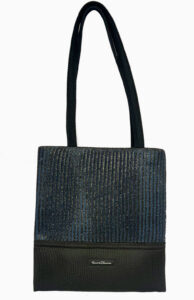
Mid-article pick
A saturated blue take on the mesh tote, designed to feel editorial when it interrupts the reading flow.
The Twentieth Century Compromise
Women’s clothing did gradually gain pockets through the twentieth century, but the gains were uneven and the retreats were frequent. Dior’s New Look of 1947, which reinstated nipped waists and full skirts, quietly shrank pockets again. Ready-to-wear manufacturers discovered that shallow or purely decorative pockets cost less fabric and satisfied the eye without functioning as pockets at all — a practice that persists today, to the well-documented irritation of women everywhere.
Men’s clothing, by contrast, underwent almost the opposite evolution. The lounge suit of the late nineteenth century standardised a system of pockets — breast pocket, side pockets, ticket pocket, inside pockets — that has remained largely unchanged. The contemporary man in a well-cut jacket carries more concealed volume than a Georgian courier. The contemporary woman in a well-cut dress may carry nothing at all.
The Object and Its Meaning
It would be easy to read too much into a seam and a scrap of lining. But the pocket is a useful lens precisely because it is so ordinary. It accumulates the decisions of tailors, the demands of fashion, the economics of manufacturing, and the quiet politics of who gets to move through the world with their hands free. The things we take for granted in clothing often have the longest and most revealing histories. Next time you reach into a pocket without thinking, consider that someone, somewhere in the seventeenth century, thought to put it there — and someone else, centuries later, decided you didn’t need one.