Somewhere around 2700 BCE, according to a story that is almost certainly legendary but too good to discard, a silkworm cocoon fell into the tea of a Chinese empress named Leizu. As she fished it out, a single continuous thread unravelled from the cocoon and wound itself around her finger. She was, the story goes, immediately enchanted. Whether or not that particular empress existed, the observation behind the story is real: a silkworm’s cocoon is one seamless strand, sometimes stretching to nearly a kilometre in length.
The Chinese turned that biological accident into one of history’s most consequential industries. By the first millennium BCE, sericulture — the cultivation of silkworms and the spinning of their cocoons — was well established in the Yangtze River basin. The resulting fabric was unlike anything produced elsewhere. It was light, strong, lustrous, and it took dyes brilliantly. It was also, by design, a mystery. The penalty for exporting silkworm eggs or revealing the production process was, under various dynasties, death.
Luxury Travelling Light
Despite those prohibitions, silk itself moved west almost from the beginning. The routes it followed were not a single road but a shifting network of paths across Central Asia — through what is now Xinjiang, Uzbekistan, Iran, and into the Levant. The term ‘Silk Road’ was coined by the German geographer Ferdinand von Richthofen in 1877; the ancients had no single name for it, because no single merchant ever travelled its full length. Goods were handed from caravan to caravan, each trader profiting by a margin before passing the bale to the next.
Silk was ideal for long-distance trade. It was light relative to its value, resistant to insect damage, and, when compressed into bales, compact. A camel could carry enough silk to make its owner wealthy at the destination. The Romans, who encountered it through Parthian intermediaries, were simultaneously entranced and appalled. The historian Pliny the Elder complained, around 77 CE, that Rome was haemorrhaging gold eastward in exchange for a fabric he described as ‘cobwebs’ — sheer enough that respectable women had no business wearing it.
From the atelier
Mid-article pick
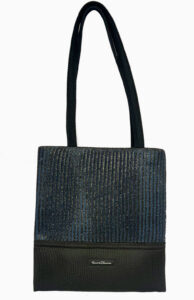
A saturated blue take on the mesh tote, designed to feel editorial when it interrupts the reading flow.
Breaking the Monopoly
The Chinese monopoly on sericulture lasted an improbably long time. It finally broke — partially — in the 6th century CE, when Byzantine agents, reportedly working under Emperor Justinian I, smuggled silkworm eggs out of China concealed in hollow canes. The Byzantines established their own silk industry, centred on Constantinople, and it became a cornerstone of their economy for the next nine centuries. Meanwhile, Arab traders and later Venetian merchants inserted themselves into the remaining trade routes, each taking their cut and each, in turn, adding to the price Western consumers paid for the fabric.
By the medieval period, silk was woven into the symbolic fabric of European power as surely as it was woven into its ceremonial robes. Kings were buried in it; saints’ relics were wrapped in it; papal vestments were made of it. The Church’s liturgical use of silk — imported, expensive, exotic — was not in contradiction to its teachings but an expression of the belief that divine worship deserved the finest materials the world could offer. The historical irony is that those materials came from a civilisation that had no knowledge of, and no interest in, Christianity.
The End of Distance
It was the Portuguese rounding of Africa in the late 15th century, and the gradual opening of sea routes, that finally eroded the overland silk trade. Sea transport was slower season-to-season but cheaper and safer at scale. The Silk Road did not disappear overnight, but its economic logic gradually dissolved. By the 17th century, Lyons in France had become Europe’s silk-weaving capital, importing raw thread and transforming it into finished fabric that it then exported back across the continent. The thread had come west; the knowledge of working it had followed; and the original monopoly had dissolved into ten thousand looms.
What the story of silk’s westward journey really illustrates is how persistently human beings have sought out materials that feel extraordinary against the skin — and how far the global economy will travel to supply that desire.