The umbrella is such an ordinary object that imagining a world without it requires an effort. But the collapsible, rain-shedding canopy on a stick is not obvious technology. It was invented once, or perhaps a few times independently in Asia, and it reached Europe relatively late and by a circuitous route. Had the transfer not happened — had the umbrella remained a Chinese and Southeast Asian object — the wet streets of eighteenth-century London might have looked very different, and so, in strange ways, might several industries and social conventions that grew around the practice of carrying one.
How It Arrived
Collapsible parasols appear in Chinese art and records from at least the fourth century CE, and probably earlier. They were status objects: in court ceremonial, the number of canopies carried above a dignitary indicated rank. The colour of the silk was significant. This solar and hierarchical meaning transferred, via trade routes and missionary contact, to Southeast Asia, where ceremonial umbrellas of great elaboration persist in royal ritual to this day.
The umbrella reached Europe via several channels — travellers’ accounts, diplomatic gifts, trade goods — and appears in Western paintings by the late sixteenth century. But it was understood for a long time as an Asian object, exotic and slightly absurd when transplanted to a northern European street. The Englishman Jonas Hanway is said to have been mocked in London in the 1750s for carrying one as protection against rain, at a time when sedan chair operators and hackney coachmen regarded the waterproof pedestrian as an economic threat to their livelihoods. Within a generation, the street umbrella was unremarkable.
From the atelier
Mid-article pick
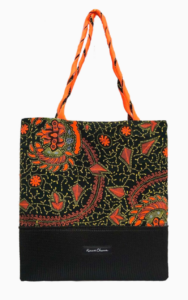
A molten orange tote with a clear focal shape, well suited to the wider in-content slot.
The Counterfactual
Imagine instead that the umbrella’s westward journey was interrupted — by a trade disruption, a war, a different diplomatic history — and that the technology remained in Asia while Europe went on getting wet. What changes?
Most immediately, the physical experience of rain in European cities would have been more determining. The cloak, already common, would have evolved more functionally; waterproofed wool and later rubberised fabrics would have become central to outerwear design rather than secondary to the parasol-and-coat combination that actually prevailed. The wide-brimmed hat — already present but declining from the eighteenth century — might have persisted longer as a rain technology rather than being superseded by the canopy over the head. The whole vocabulary of wet-weather dress could have taken a different direction, perhaps toward something resembling the functional oilskins of the sailor rather than the elegant furled stick of the city dweller.
The social life of the umbrella is harder to replace. In nineteenth-century Britain, the rolled black umbrella became an accessory of bourgeois respectability almost as codified as the top hat. Carrying one — a silk one, properly rolled — communicated that you were the kind of person who owned a silk umbrella. A world without this particular prop would have needed other props, and it would have found them, but they would have shaped different social performances.
Industry and Infrastructure
By 1851, there were umbrella manufacturers in Britain employing thousands of workers in a supply chain that ran from steel frame makers in Birmingham to silk weavers in Spitalfields. The umbrella trade was a small but real industrial ecosystem. Without it, those craft capacities might have clustered around different goods — cane furniture frames, hat frames, other light metalwork — or the steel-bending and silk trades might have found equilibrium at slightly different volumes and geographies. These are modest changes, but industrial history runs on modest changes compounding over decades.
What we cannot easily substitute is the symbolic function. The umbrella left indelible marks on art and literature — Renoir’s The Umbrellas, Manet’s rain-soaked Paris canvases, the bowler-hatted figure with the furled umbrella as a shorthand for a certain kind of Englishness. A world without the street umbrella would have found other images, naturally. But the specific iconography of the modern European city — the sea of black domes on a wet morning platform — would be absent, replaced by something we cannot quite picture from here.
The umbrella is a small technology. It keeps one person dry in a small radius. But small technologies, when they become universal, accumulate meanings far beyond their function. The counterfactual reminds us that we are always just a few absent trade routes away from a different visual world.