The scarf is, structurally, the simplest textile accessory imaginable: a length of cloth worn around the neck, the head, or the shoulders. It requires no construction beyond weaving the fabric and finishing the edges. Unlike the hat, it needs no shaping. Unlike the glove, it needs no tailoring. And yet scarves appear in the historical record in an enormous range of contexts, serving functions from the purely thermal to the highly ceremonial, and they carry a social weight that their simplicity does not obviously explain.
The Oldest Function
Fabric around the neck for warmth is probably as old as textile production itself, and that is old: the earliest known woven textiles date to around 7000 BCE. But the first scarf to enter the historical record in something like its recognisable form appears in China, during the reign of the first emperor, Qin Shi Huang. The terracotta warriors of his burial complex, created in the third century BCE, are depicted wearing cloth bands around their necks. These are not decorative: they appear to be practical garments, perhaps for dust protection or warmth in the field.
Roman soldiers wore the focale, a cloth wrapped around the neck, under their armour — again primarily for protection, preventing the metal from chafing the skin. The Roman association of neck cloth with military function is worth noting, because it recurs throughout history: the scarf’s journey from military utility to civilian fashion is a pattern it shares with the cravat, the necktie, and the stock, all of which begin as functional soldier’s neckwear and end as status accessories.
The Cravat and Its Children
The modern necktie’s direct ancestor is the cravat, a soft neckcloth whose introduction to Western Europe in the seventeenth century is conventionally attributed to Croatian mercenaries serving in the Thirty Years War, whose knotted neck cloths were noticed and adopted by French fashionable society. (Cravate may derive from Croate, Croatian.) Whether this etymology is strictly accurate or partly folk etymology, the timing is real: the cravat swept through European fashion from the 1640s onward, replacing the starched ruff that had dominated formal dress for nearly a century.
The art of tying the cravat became, in the eighteenth and early nineteenth centuries, a genuine skilled practice with a literature of its own. Beau Brummell, the Regency arbiter of male dress, was reported to devote his mornings to the tying of his cravat, with the floor reportedly littered with rejected attempts. In 1828, a publication entitled Neckclothitania, or Tietania: Being an Essay on Starchers catalogued and illustrated fourteen distinct cravat knot styles. The necktie that descended from this tradition, settling into its current form in the 1920s, is still today tied in knots with names — the Windsor, the half-Windsor, the four-in-hand — that preserve this preoccupation with the correct arrangement of neck fabric.
From the atelier
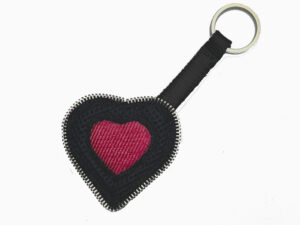
Mid-article pick
A lighter-priced heart shape that still gives the break in the post a clear commercial moment.
The Square and the Oblong
The fashion scarf as a distinct category from the necktie and cravat developed primarily in the twentieth century. The square silk scarf, folded diagonally and tied at the throat or worn over the head, became a major accessory in the mid-century. Hermès, which began as a harness maker in 1837 and produced its first silk scarf in 1937, developed the carré — a ninety-centimetre square of silk printed with equestrian, heraldic, or narrative designs — into one of the most recognised luxury objects of the twentieth century. Grace Kelly folding a Hermès scarf into a sling for her injured arm after a car accident in 1956 (the same year she was photographed with the Kelly bag) created an image that the house has drawn on ever since.
The oblong scarf — the winter scarf as most people now imagine it, typically wool or cashmere, worn loose around the neck or wrapped for warmth — became a major category as the ready-to-wear market expanded in the postwar decades. Cashmere, sourced from the fine undercoat of the Kashmiri goat and produced primarily in Scotland’s borders region and later in Mongolia and China, became the preferred material for the prestige winter scarf — soft enough to wear next to skin, warm enough to be genuinely useful, expensive enough to signal expenditure, and plain enough to avoid looking like it was trying too hard.
The Scarf and the Face
The scarf’s persistence across all its forms and centuries reflects something the simplest analysis would miss: it frames the face. Of all the accessories, the scarf sits closest to the features we use to read each other — at the base of the face, around the neck, sometimes over the head. A scarf changes the colour and shape of the frame around a face in a way that is immediately visible at conversational distance. This may explain why scarves appear in so many different cultures and periods: the functional object (warmth, dust protection) happens to occupy the most socially legible position on the body. Once there, it accumulates meaning faster than almost any object that doesn’t actually cover the face. The face tells you who someone is; the scarf tells you something about how they understand themselves. Both messages are sent simultaneously, which is perhaps more information than a simple rectangle of fabric has any right to carry.