Introduction: Why Bags Matter
The bag is one of the oldest and most universal of all human inventions — so fundamental that we rarely pause to consider its extraordinary history.
Long before the wheel, the plough, or even the first permanent shelter, human beings needed a way to carry things. Food gathered from the wild, tools chipped from flint, infants who could not yet walk — all of these demanded a container that could move with the body. The bag, in its simplest form, was the answer to one of our species’ earliest logistical problems: how to free the hands while transporting the essentials of survival.
Over the millennia, bags have evolved from crude animal-hide wrappings into objects of astonishing diversity. They have served as symbols of social status, instruments of trade, tools of warfare, expressions of artistic vision, and engines of billion-pound fashion empires. The history of the bag is, in a very real sense, a history of civilisation itself — reflecting changes in technology, economy, gender roles, and cultural values at every turn.
The First Bags: Prehistory to the Bronze Age
The Oldest Evidence
The earliest bags predate written history by tens of thousands of years. Archaeological evidence suggests that humans were using simple pouches made from animal hides, woven plant fibres, and bark as early as 40,000 years ago. These were not luxury goods but necessities — containers for carrying foraged seeds, medicinal herbs, sharp flint tools, and fire-making materials.
One of the most famous early examples comes from Ötzi the Iceman, whose remarkably preserved body was discovered in the Alps in 1991. Ötzi, who lived around 3300 BCE, was found carrying a belt pouch made of calfskin that contained a flint scraper, a drill, a bone awl, and dried tinder fungus. This was, in effect, an everyday carry kit from the Copper Age — a practical bag designed for the essentials of Neolithic life.
Ötzi’s Belt Pouch (c. 3300 BCE)
Discovered in the Italian Alps in 1991, Ötzi the Iceman carried a calfskin belt pouch containing flint tools, a bone awl, and tinder fungus. It is one of the oldest surviving personal bags ever found and reveals how essential portable containers were even in the Copper Age.
Even earlier than Ötzi, woven bags and baskets appear in the archaeological record. Fragments of woven plant-fibre containers dating to around 10,000 BCE have been found in sites across the Near East. The transition from hunting and gathering to agriculture made bags even more critical: harvested grain needed to be collected, transported, and stored, creating demand for larger, more durable containers.
Who Used the First Bags?
The short answer is: everyone. Bags were not the preserve of any single culture, class, or gender. Hunter-gatherer societies across Africa, Asia, Europe, the Americas, and Australia all independently developed carrying containers suited to their environments. Aboriginal Australians wove dilly bags from plant fibres to carry food and sacred objects. Indigenous peoples of the Great Plains crafted parfleches — folded rawhide containers — for dried meat and personal possessions. In sub-Saharan Africa, woven baskets and hide bags were central to daily life.
What varied was the material and construction technique, shaped by local ecology: reeds and grasses in wetland regions, animal hides on the steppe, bark in forested areas, and woven cotton or linen where textile technology had advanced. The impulse to create a portable container, however, appears to be genuinely universal.
Bags in the Ancient World
Egypt, Mesopotamia, and the Classical World
In ancient Egypt, bags took on symbolic as well as practical significance. Wall paintings in tombs from the Old Kingdom (c. 2686–2181 BCE) depict servants carrying linen sacks of grain and leather pouches of gold dust. Pharaohs were buried with ornamental bags intended for use in the afterlife. Hieroglyphic texts reference bags used in trade, tax collection, and temple offerings.
Mesopotamian civilisations similarly relied on bags for commerce. Clay tablet records from Ur and Babylon describe shipments of goods packed in leather and woven sacks. The Akkadian word for a leather bag, “masak-ku,” appears frequently in trade inventories, pointing to the bag’s central role in early mercantile economies.
In ancient Greece and Rome, personal bags became markers of identity. Roman legionaries carried a sarcina — a heavy kit bag slung from a forked pole over the shoulder — containing rations, cooking implements, and personal effects for long marches. Civilian Romans used leather pouches called loculi for coins and small valuables, often worn on a belt or tucked into the folds of a toga. Greek women carried small fabric bags for cosmetics and personal items, sometimes richly embroidered.
The Mysterious Handbag of the Gods
One of the most intriguing motifs in ancient art is the so-called “handbag of the gods” — a bucket-shaped container depicted in the hands of divine or semi-divine figures across multiple unconnected civilisations. It appears in Sumerian reliefs at Nineveh, in Olmec stone carvings in Mesoamerica, at the megalithic site of Göbekli Tepe in Turkey (dating to c. 9500 BCE), and in Maori art from New Zealand. The purpose and meaning of this symbol remain debated, but its widespread appearance suggests that the bag held deep symbolic or ritual significance in the ancient world.
The Medieval and Renaissance Bag
Purses, Girdle Pouches, and Almoners
In medieval Europe, the bag evolved into a highly personal accessory. Both men and women wore small leather pouches attached to a belt or girdle, known variously as purses, scrips, or almoners (the latter used specifically for carrying alms to give to the poor). These girdle pouches were the primary means of carrying coins, keys, prayer beads, and small personal items in an era before pockets were commonplace.
Medieval purses were often elaborately decorated. Surviving examples from the 14th and 15th centuries feature intricate embroidery, metalwork clasps, and heraldic designs. The Chaucer’s Canterbury Tales mentions pilgrims carrying distinctive pouches, and medieval illuminated manuscripts frequently depict merchants, pilgrims, and nobility with bags appropriate to their station.
The Invention of Pockets (c. 17th Century)
Before pockets were sewn into garments in the 1600s, almost everyone — regardless of wealth or gender — relied on external bags and pouches for carrying personal items. The introduction of pockets into men’s clothing gradually reduced male dependence on bags, while women’s fashion continued to exclude functional pockets, driving the development of the handbag.
Trade and Travel Bags
The expansion of trade routes during the medieval and early modern period created demand for larger, more robust bags. Merchants on the Silk Road used saddlebags of thick leather and woven wool to transport spices, silk, and precious metals across thousands of miles. Pilgrims to Jerusalem, Canterbury, or Santiago de Compostela carried scrip bags for food and documents. Soldiers and couriers used messenger bags and dispatch cases. The bag was, in effect, the luggage infrastructure of the pre-industrial world.
The Industrial Revolution and the Birth of Modern Luggage
From Craftsmen to Factories
The Industrial Revolution transformed bag-making from a craft into an industry. Mechanised looms produced canvas and textiles at unprecedented scale, while advances in metalwork enabled mass production of buckles, clasps, and frames. The expansion of the railway network in the 19th century created an entirely new category of bag — luggage designed for train travel — and with it, an entirely new market.
It was in this period that several of the world’s most famous bag and luggage houses were founded. Louis Vuitton opened his trunk-making workshop in Paris in 1854, initially producing flat-topped trunks that could be stacked in railway carriages. Hermès, founded in 1837, began as a saddlery before expanding into leather bags and travel goods. In England, the Gladstone bag — a hinged leather holdall named after Prime Minister William Gladstone — became the quintessential doctor’s bag and gentleman’s travel companion.
From the atelier
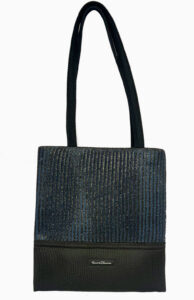
Mid-article pick
A saturated blue take on the mesh tote, designed to feel editorial when it interrupts the reading flow.
Key Milestones in Bag History
Era
Development
c. 40,000 BCE
Earliest evidence of hide and plant-fibre carrying pouches used by hunter-gatherers
c. 3300 BCE
Ötzi the Iceman’s calfskin belt pouch — one of the oldest surviving personal bags
c. 2500 BCE
Egyptian tomb paintings depict linen grain sacks and leather trade pouches
c. 500 BCE
Roman legionaries carry the sarcina kit bag on long military marches
c. 1200 CE
Medieval girdle pouches become standard personal accessories across Europe
c. 1600s
Pockets sewn into men’s clothing begin to replace external pouches for men
1837
Hermès founded in Paris as a saddlery, later expanding into leather bags
1854
Louis Vuitton opens his trunk-making atelier in Paris
1892
The zipper is patented, eventually revolutionising bag closures
1930s
Hermès introduces the Sac à Dépêches, later renamed the Kelly bag
1941
Coach is founded in New York, pioneering accessible American leather goods
1955
Chanel launches the iconic 2.55 quilted flap bag
1984
Hermès Birkin bag created after a chance meeting between Jane Birkin and Jean-Louis Dumas
2000s
The “It Bag” era: designer handbags become global status symbols
2020s
Sustainable materials, gender-neutral designs, and tech-integrated bags reshape the market
The Rise of the Handbag: Gender, Fashion, and Status
Women and the Reticule
As men’s clothing gained pockets in the 17th century, the external bag gradually became gendered. Women’s fashion, with its emphasis on slim silhouettes and flowing fabrics, rarely accommodated functional pockets. Instead, women carried tie-on pockets beneath their skirts — accessible through slits in the fabric — or small drawstring bags called reticules (also known as “ridicules” by their early critics).
The reticule, which emerged in the late 18th century alongside the thin, high-waisted Empire-line dresses of the Neoclassical period, was the direct ancestor of the modern handbag. Made of silk, velvet, or embroidered fabric and carried in the hand or over the wrist, it was small, decorative, and visible — a public accessory rather than a hidden one. For the first time, a woman’s bag became a fashion statement.
The 20th Century: Handbags as Icons
The 20th century elevated the handbag from practical accessory to cultural icon. The 1920s and 1930s saw the rise of elegant clutch bags carried by flappers and film stars. The post-war period produced some of the most recognisable bags in history.
In 1955, Coco Chanel introduced the 2.55 bag — named for its launch date of February 1955 — with its quilted leather, chain strap, and burgundy lining. It was designed to free women’s hands at a time when most bags still required one hand to hold. The Chanel 2.55 remains one of the most coveted bags in the world.
In 1956, Grace Kelly was photographed using a Hermès Sac à Dépêches to shield her pregnant stomach from paparazzi. The image was published worldwide, and Hermès renamed the bag the “Kelly” in her honour. Nearly three decades later, the Hermès Birkin bag was born from a chance encounter between actress Jane Birkin and Hermès chief executive Jean-Louis Dumas on a flight from Paris to London in 1984. Both bags now routinely sell for tens of thousands of pounds and have become investment-grade luxury goods.
The “It Bag” Phenomenon
The late 1990s and 2000s witnessed the emergence of the “It Bag” — a single handbag style that dominated a fashion season and became an object of intense consumer desire. The Fendi Baguette, Balenciaga City, Chloé Paddington, and Mulberry Alexa all enjoyed their moment as the bag to be seen carrying. Celebrity culture, fashion magazines, and the rise of street-style photography amplified this phenomenon, turning certain bags into shorthand for taste, wealth, and social belonging.
The economics were staggering. By the mid-2000s, handbags and small leather goods accounted for the largest share of revenue at many luxury fashion houses, frequently exceeding the contribution of clothing. The bag had become the engine of the luxury industry.
Bags Beyond Fashion: Utility, War, and Work
Military Bags
From the Roman sarcina to the modern soldier’s Bergen rucksack, military bags have driven some of the most significant innovations in bag design. The knapsack, haversack, and ammunition pouch were standard issue across European armies for centuries. During the First World War, the trench-bound conditions of the Western Front demanded waterproof, durable containers, leading to advances in treated canvas and rubberised fabrics.
The Second World War produced the iconic duffel bag (named after the Belgian town of Duffel, where the heavy cloth was made), the paratrooper’s jump bag, and the ammunition bandolier. Many of these military designs were subsequently adopted for civilian use — the canvas tote, the messenger bag, and the surplus rucksack all have military ancestry.
Working Bags
Certain professions have become inseparable from their bags. The doctor’s Gladstone bag, the barrister’s briefcase, the postman’s satchel, the schoolchild’s backpack, the photographer’s camera bag, and the tradesman’s tool belt are all examples of bags shaped by the demands of a specific occupation. Each evolved to solve a particular set of carrying problems — weight distribution, quick access, protection of contents, hands-free operation — and each became a visual shorthand for the profession it served.
The Backpack Revolution
The backpack deserves special mention as one of the most transformative bag designs in history. While shoulder-carried packs have existed for millennia, the modern framed backpack originated in the late 19th century with the hiking and mountaineering movements in Europe and North America. In the 1960s and 1970s, lightweight nylon backpacks became popular with students and counterculture travellers. By the 1990s, the backpack had become the default school bag for children across the Western world and, increasingly, the preferred commuting bag for urban professionals.
The 21st Century: Sustainability, Technology, and the Future
Sustainable and Ethical Bags
The environmental impact of bag production — particularly the use of animal leather, synthetic plastics, and fast-fashion manufacturing — has become a major concern in the 21st century. A growing number of designers and brands are experimenting with alternative materials: mushroom-derived leather (mycelium), pineapple-leaf fibre (Piñatex), recycled ocean plastic, and lab-grown bio-fabrics. The single-use plastic bag, once ubiquitous, has been banned or taxed in dozens of countries.
At the same time, the market for handmade, artisanal bags has grown, driven by consumers seeking unique, ethically produced accessories with genuine craft heritage. Small-scale makers working with sustainably sourced leather, natural dyes, and traditional techniques offer an alternative to mass-produced fashion.
The Plastic Bag: A Brief Cautionary Tale
The lightweight polyethylene shopping bag was introduced in 1965 by a Swedish company and became globally dominant by the 1980s. An estimated 5 trillion plastic bags are used worldwide each year. Their environmental damage — to oceans, wildlife, and landscapes — has made them one of the most visible symbols of the throwaway economy, prompting bans and levies in over 120 countries.
Smart Bags and Tech Integration
The latest chapter in bag history involves the integration of technology. Modern bags now feature built-in USB charging ports, GPS trackers, solar panels, RFID-blocking pockets, and anti-theft designs. Smart suitcases with self-weighing scales, fingerprint locks, and Bluetooth connectivity represent the frontier of bag innovation. As wearable technology and mobile computing continue to evolve, the bag is likely to become an increasingly active component of our digital lives.
Gender-Neutral and Inclusive Design
The rigid gendering of bags — handbags for women, briefcases for men — has begun to dissolve. Many contemporary designers offer gender-neutral ranges, and the cultural acceptance of men carrying bags (beyond the purely utilitarian rucksack) has grown considerably. Crossbody bags, totes, and small shoulder bags are now worn across the gender spectrum, reflecting broader shifts in fashion and identity.
Conclusion: The Bag as Human Companion
The bag is so ordinary, so embedded in daily life, that it can seem invisible. Yet its history stretches from the Palaeolithic to the present day, encompassing every civilisation, every social class, and every human need from survival to self-expression. It has been a tool, a weapon, a status symbol, a work of art, and a statement of identity.
What distinguishes the bag from most other objects is its intimate relationship with the body and with movement. A bag goes where we go. It holds what we value. It reflects our priorities, our aesthetics, and our practical needs at a particular moment in time. In this sense, the bag is one of the most personal of all human artefacts — and one whose story is far from over.
The history of the bag is ultimately the history of human ingenuity applied to one of life’s most basic challenges: how to carry the things that matter.