The bag is older than the wheel. Before humans had pottery or weaving, they needed to carry things — food, tools, fire-making materials — and the solution was a skin or woven pouch slung over a shoulder or clutched in a hand. The archaeological record is patchy for perishables, but bags made from animal bladders, plant fibre, and leather appear in burials and middens going back thousands of years. The handbag, in the broadest sense, may be the oldest piece of human technology that hasn’t changed its fundamental form.
From Utility to Symbol
The symbolic life of the bag began early. In ancient Egypt, gods and pharaohs were depicted carrying bags in reliefs — not workaday sacks, but objects of refined craft, embroidered or beaded, that signalled access to resources and to the divine. Greek vase paintings show figures with leather satchels. Roman soldiers carried the loculus, a leather bag whose contents were standardised by military regulation. Even at this early stage, a bag was not just a bag: it indicated profession, rank, and access.
Medieval European depictions of bags — the aumônière, a fine pouch carried at the belt — show them as objects of courtly display. Surviving examples in museum collections are often made of silk or velvet, heavily embroidered with scenes from romance literature or religious iconography. These were given as gifts between lovers and patrons. The bag was a message as much as a receptacle.
The Reticule and the Birth of the Modern Handbag
The story of the modern handbag begins, as noted elsewhere, with a fashion crisis. When the neoclassical silhouettes of the early nineteenth century eliminated functional pockets from women’s dress, women needed somewhere to put their necessities. The solution was the reticule — from the Latin reticulum, a net — a small drawstring bag carried in the hand or over the wrist. Contemporary satirists called it a ridicule, mocking both the name and the absurdity of carrying one’s belongings externally.
But the reticule was the seed from which the modern industry grew. By the Victorian era, bags had proliferated into specialised forms: the chatelaine bag hung from a decorative clasp at the waist, the carpet bag travelled on trains, the evening bag in beaded silk or satin appeared at balls, the leather Gladstone bag went to the office or on long journeys. Each form was calibrated to a social context. To appear at an evening entertainment with a day bag was a faux pas of the kind that Victorian conduct literature catalogued with relish.
From the atelier
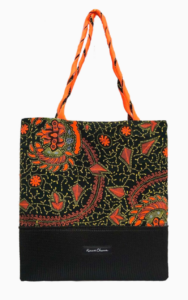
Mid-article pick
A molten orange tote with a clear focal shape, well suited to the wider in-content slot.
The Twentieth Century and the Logic of the Logo
The handbag as a luxury object in its modern sense took shape in the early twentieth century. Louis Vuitton had been making trunks and travel bags since the 1850s, developing the flat-topped trunk specifically to stack in the new luggage vans of the railways. By the 1920s, houses like Chanel and Hermès were making handbags with the same craft attention given to couture. The Hermès Kelly bag — named after Grace Kelly, who was photographed using one to shield her pregnancy from a photographer in 1956 — and the Birkin, designed in 1984 after a chance meeting on a plane between Jean-Louis Dumas and actress Jane Birkin, became objects of extraordinary cultural cachet.
What made the luxury handbag different from all previous forms of the bag was the explicit logic of the logo. A bag with a house’s monogram or pattern announced its price and the social position of its carrier in a way that even highly decorated medieval pouches had not quite managed. The bag became a pure status signal — portable, visible, and readable from across a room. By the early twenty-first century, certain bags had become financial instruments, traded on secondary markets and appreciating in value more reliably than some stocks.
What We Are Really Carrying
The contents of an average handbag have not changed as dramatically as the bags themselves. Phone, keys, cards, a small amount of cash, something for lips or face, perhaps a pen: these are not fundamentally different from the necessities a Roman matron would have recognised — a wax tablet instead of a phone, coins instead of cards, but the same logic of portable, personal essentials. What has changed is the outer shell and what it communicates. The bag we choose, or can afford, remains one of the most legible signals we send about ourselves — a fact the industry understands perfectly and has monetised with remarkable efficiency. The ancient Egyptian scribe with his finely worked leather bag would have understood the arrangement completely.